| IOP Solar Editorial Richard Hanson-Graville, DPS Tel 01372 803643, Fax 01372 803678, Email R@heatweb.com 15th August 2000 See also:
There are four main parts to a typical pumped solar system: solar panels, a water store, connecting pipework, and controls, typically comprising of a pump and a controller. The panels fitted to the roof collect heat from the sun, using it to heat water. This water is then circulated to the store, which can be either a vented or unvented cylinder, or a thermal store, typically fitted with a dedicated coil to transfer heat into the store. The controller monitors the temperatures in the panel and in the store, via dedicated temperature sensors, and will activate the solar pump to circulate heat from the panel to the store when available (typically when the panel is around 5°C hotter than the store). The solar system can be thought of as a separate primary circuit, installed as either a sealed system (using an expansion vessel, filling loop and pressure relief valve, or as a vented system connected to a feed and expansion tank (higher than the panels). All pipework should be well insulated.
Solar Panels: The size of panels required for a domestic
property is anywhere between 2m2 and 7m2, with
panels fitted to the roof either using simple support brackets, or by
recessing into the roof. The water in the solar system must usually be
dosed with anti-freeze to prevent frost damage to the panels, however
certain systems can overcome this.
The Solartwin panel system is retro-fitted to an existing vented cylinder. The need for a controller is removed by the use of a second small photovoltaic panel to power a solar pump, which pumps cold water from the cold feed connection to a cylinder, returning it hot to the top of the cylinder via the hot water draw off. The panels can resist freezing as the collector tubes within the panel are made of rubber and will not burst, however protection may be needed against limescale build up within the solar system. Evacuated Tube Collectors are constructed of glass solar collector tubes, containing a second inner tube with a selective coating. The space between the outer tube and inner tube is evacuated and maintained at a high vacuum eliminating all heat loss by conduction and convection. Solar radiation passes through the highly transparent outer glass tube and reaches the solar selective coating on the outside of the inner tube. The solar selective coating absorbs the solar radiation and converts it to thermal energy.
The second type are Evacuated Heat Pipe Collectors and differ in that they consist of a heat pipe inside a vacuum-sealed tube. Each tube contains a sealed copper pipe (heat pipe) that is attached to a black copper fin absorber plate. As the sun shines on the black surface of the fin, alcohol within the heat tube is heated and hot vapour rises to the top of the pipe. Water, or glycol, flows through a manifold picking up the heat, while the alcohol condenses and flows back down into the tube. Both the Thermomax Memotron tubes and the Viessmann's Vitosol 300 tubes work on this principle, and both have the added advantage of built in overheat protection - when a programmed temperature has been achieved, a 'memory metal' spring expands and pushes a plug against the neck of the heat pipe blocking the return of the condensed fluid and stopping heat transfer. Photo Voltaic Panels (PVs) convert sunlight into electricity. Although not as efficient as panels used to heat water, they have a huge variety of applications from the large-scale production of electricity in sunny countries to recharging the batteries in watches and calculators, however the only time they apply to plumbing is when used as an electricity source for pumps or controls. The Solar Store:
The most common type of store is a twin coil cylinder, with one coil at the bottom of the store dedicated to solar, and the second connected to a standard boiler system to provide heat when the solar input is not enough. Alternatively, two stores can be used, one heated by the solar, and one by the boiler. Solar versions of nearly all types of cylinder are available, and many panels can be supplied with their own dedicated solar store.
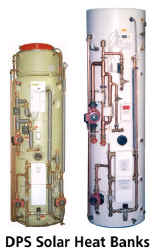
Plate heat exchangers can be used to heat a hot water store that is not fitted with a dedicated solar coil, and as such can be used to convert cylinders to use solar. Ideally the store should have two spare bosses for connection to the heat exchanger. The exchanger transfers heat from pumped panel water to the store water, also pumped from the store. Heat exchangers are very efficient at transferring heat and are particularly suited to district or commercial applications. Controls: The choice of which solar controller to use will depend upon the type of system. A Basic system can make use of straightforward controllers, which are no more difficult to install than a central heating timeclock. Many include a digital read-out of water temperatures in the panels and store, and one should rarely need to use the more advanced controllers available. The controller will typically need wiring to two sensors (one on the solar panel, and one on the solar store or adjoining pipework), to the solar pump, and to the mains electrical supply. Pre-assembled controls packs are also available, such as Solar Sense's Consol unit, as well as fully pre-assembled units such as our own DPS Cel-F Solar Heat Bank Thermal Store. Summary: The choice of which system to use comes down to a
balance of panel efficiency, size, cost, the guarantees on the panels,
the appearance of the panels, and simplicity of installation. One should
obtain quotes and performance data for a variety of panel types, as well
as looking at the cost of associated controls, before making a final
decision. Although the range of systems available may seem a bit
daunting at first, do not worry. They are all pretty similar in general
operation, and should prove as easy as installing a
typical boiler system. |
 How to increase
efficiency dramatically by proper mixing
How to increase
efficiency dramatically by proper mixing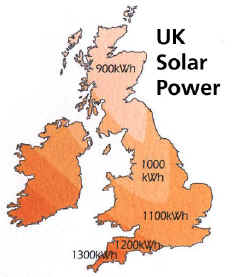 Solar systems are not new, and have been used the
world over for decades. They have, however, even with over 40,000
systems installed, never really made it into
mainstream use in the UK. We receive sufficient sunshine to
provide up to 70% of our annual domestic hot water needs from a well
designed solar installation and such a system will also reduce harmful
emissions by up to 500 kg per square metre of panel per year. Solar hot
water and heating systems are becoming cheaper and more efficient,
helped by government initiatives such as the reduction in VAT to 5% on
both parts and labour for domestic installations that can demonstrate an
improvement to energy efficiency. Now is the time for UK plumbers to get
to grips with solar technology, and start presenting it as a serious
option to customers.
Solar systems are not new, and have been used the
world over for decades. They have, however, even with over 40,000
systems installed, never really made it into
mainstream use in the UK. We receive sufficient sunshine to
provide up to 70% of our annual domestic hot water needs from a well
designed solar installation and such a system will also reduce harmful
emissions by up to 500 kg per square metre of panel per year. Solar hot
water and heating systems are becoming cheaper and more efficient,
helped by government initiatives such as the reduction in VAT to 5% on
both parts and labour for domestic installations that can demonstrate an
improvement to energy efficiency. Now is the time for UK plumbers to get
to grips with solar technology, and start presenting it as a serious
option to customers.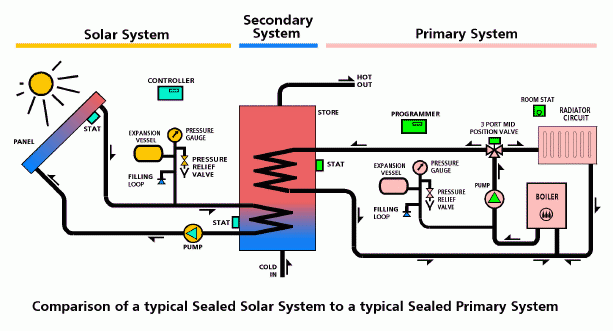
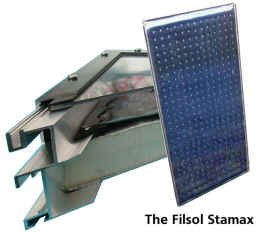
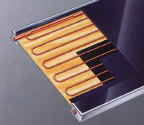 Flat Plate Collectors are made of a metal
collector plate, usually copper, coated in special materials and fitted
into an insulated box. Tubes running along the collector carry water,
and heat is conducted from the surface of the collector into the water.
The range of flat plate collectors is quite large offering very good
value for money, with panels available from AES (as fitted at
our own premises), Filsol, Solar Sense, Powertech, Viessmann, and others. Flat plate collectors can also be
'home-made' with a number of workshops around the country set up to
provide training.
Flat Plate Collectors are made of a metal
collector plate, usually copper, coated in special materials and fitted
into an insulated box. Tubes running along the collector carry water,
and heat is conducted from the surface of the collector into the water.
The range of flat plate collectors is quite large offering very good
value for money, with panels available from AES (as fitted at
our own premises), Filsol, Solar Sense, Powertech, Viessmann, and others. Flat plate collectors can also be
'home-made' with a number of workshops around the country set up to
provide training.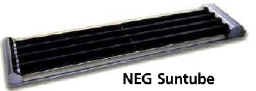
 The
first type of evacuated collectors are Direct Flow Evacuated Tube Collectors which heat up
water flowing through the tubes. Panels worth noting are the Riomay NEG
Suntube (20 year guarantee), the Solamax
from Thermomax, the Viessmann Vitosol 200, and the Seido
3 Combi-Collector from PowerTech which has a built in 40 litre
mains water store that can be used to provide a pre-heated water supply
to a standard unvented cylinder or thermal store (also avoiding the need
for a pump, controller, or anti-freeze).
The
first type of evacuated collectors are Direct Flow Evacuated Tube Collectors which heat up
water flowing through the tubes. Panels worth noting are the Riomay NEG
Suntube (20 year guarantee), the Solamax
from Thermomax, the Viessmann Vitosol 200, and the Seido
3 Combi-Collector from PowerTech which has a built in 40 litre
mains water store that can be used to provide a pre-heated water supply
to a standard unvented cylinder or thermal store (also avoiding the need
for a pump, controller, or anti-freeze).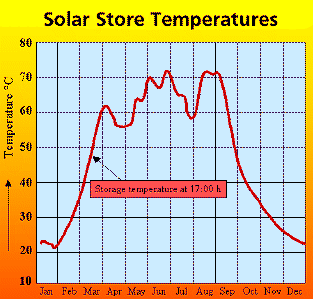 The choice of store to use in conjunction with panels
is dependent on the type and area of panels used. As the heat input from
the panels cannot usually be limited, the store needs to be large enough
to absorb all the heat delivered by the panels. Protection against
overheating may be needed, however correctly matching the panel size to
the size of the store should overcome this (the larger the store the
less chance of overheat). A general rule for sizing stores is 60 litres
per square metre of panel, however this will depend upon the panel
efficiencies.
The choice of store to use in conjunction with panels
is dependent on the type and area of panels used. As the heat input from
the panels cannot usually be limited, the store needs to be large enough
to absorb all the heat delivered by the panels. Protection against
overheating may be needed, however correctly matching the panel size to
the size of the store should overcome this (the larger the store the
less chance of overheat). A general rule for sizing stores is 60 litres
per square metre of panel, however this will depend upon the panel
efficiencies.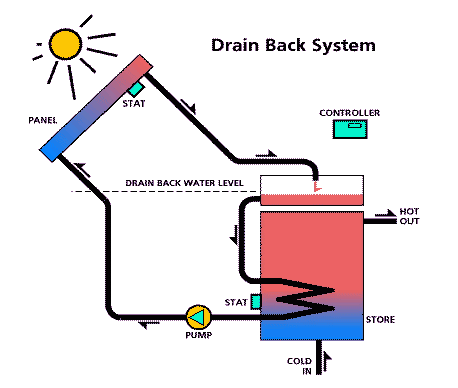 Drain-back systems overcome problems associated
with freezing or overheat by allowing the water to drain out of the
panels back into a thermal store during freezing or overheat. During
normal operation, the solar pump forces water up to the panels. On some
systems, the pump must be on to keep water in the panels, whereas some
may make use a control valve to allow water to drain. Thermostats on the
panel or pipework can be used to sense freezing or overheat conditions
respectively. With drain-back systems, special care must be taken to
avoid air locks within the solar pipework.
Drain-back systems overcome problems associated
with freezing or overheat by allowing the water to drain out of the
panels back into a thermal store during freezing or overheat. During
normal operation, the solar pump forces water up to the panels. On some
systems, the pump must be on to keep water in the panels, whereas some
may make use a control valve to allow water to drain. Thermostats on the
panel or pipework can be used to sense freezing or overheat conditions
respectively. With drain-back systems, special care must be taken to
avoid air locks within the solar pipework.